
Hydrolyzed Protein vs Collagen Peptides for Pets
Are hydrolyzed-protein pet foods and collagen peptides the same? Compare product roles, labels, dog and cat studies, and evidence limits.
Are hydrolyzed-protein pet foods and collagen-peptide supplements the same thing? No. Hydrolyzed protein describes a source protein that has been broken into smaller components and incorporated into a finished food or diet. Collagen peptides are hydrolyzed fragments derived from collagen and may be sold as a separate ingredient or supplement. Undenatured type II collagen is a third form, not a synonym for collagen peptides. Compare the exact source, processing, finished product, species, purpose and measured outcome before carrying research from one category to another.

Start with the label, not the word hydrolyzed
A complete elimination diet, a collagen powder, an undenatured collagen chew and a research peptide can all contain smaller protein-related molecules. They are still different products with different evidence.
This AI-assisted guide is an evidence and label comparison, not a systematic review, feeding plan or veterinary recommendation. Primary dog and cat studies plus current FDA and AAFCO label context were checked November 6, 2026. It answers a distinct buying question left by the existing dog collagen buying guide, skin-and-coat evidence guide and collagen label guide: when does the word hydrolyzed identify a complete diet, a collagen ingredient or something else?
Hydrolysis is a process, not a single product category
Hydrolysis breaks larger proteins into smaller components. That description alone does not identify the animal source, the distribution of fragment sizes, the finished formulation, the intended purpose or the amount present. A hydrolyzed salmon elimination diet and a porcine collagen-peptide preparation can both involve hydrolysis while sharing little else.
For pet owners, the first useful distinction is the role of the finished product. A complete and balanced food is designed to provide daily nutrition for a stated species and life stage. A complementary feed, topper, chew or powder does not automatically replace a complete diet. FDA explains that a complete-and-balanced claim depends on the nutritional adequacy statement, while AAFCO label guidance separates complete foods from treats and supplements.
The second distinction is the reason the product is being considered. A veterinarian-directed elimination diet addresses a diagnostic and management question in an animal with suspected food reaction. A collagen preparation may be investigated for joint mobility or another specific outcome. One category does not validate the other.
Four categories that should not be collapsed
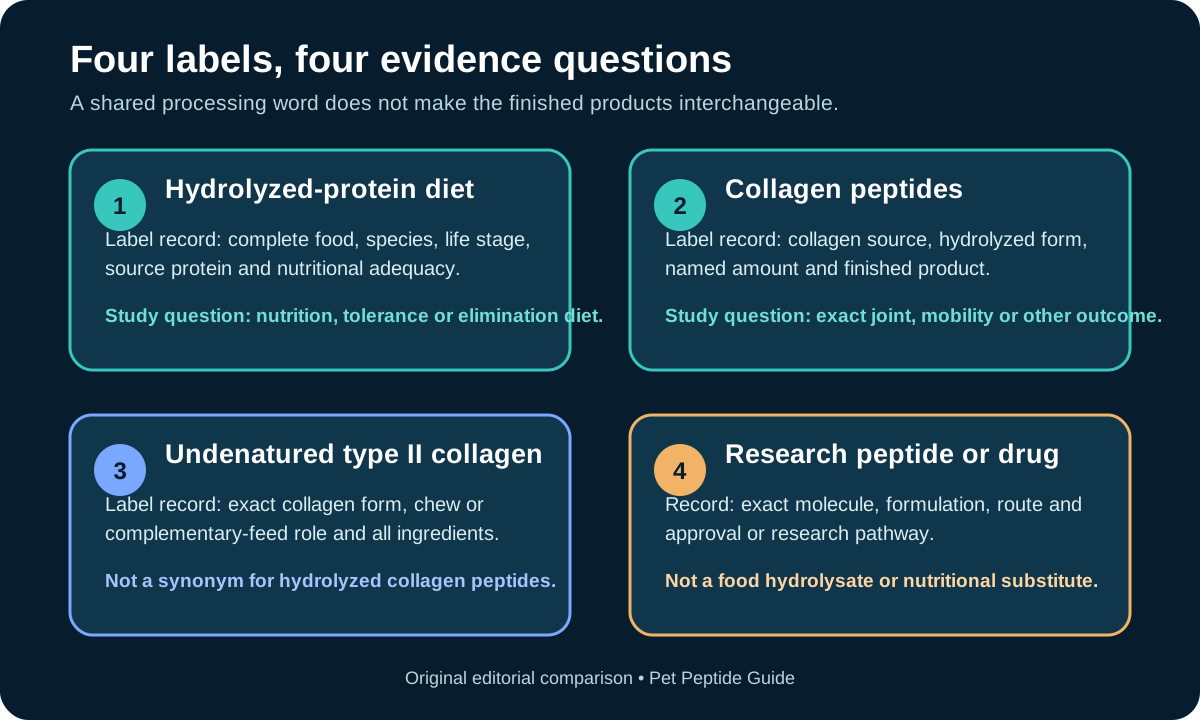
| Category | What the label should identify | A question research may answer | What cannot be assumed |
|---|---|---|---|
| Complete hydrolyzed-protein diet | Species, life stage, nutritional adequacy statement, source protein, ingredient list and feeding directions. | Digestibility, nutrition, tolerance or a veterinarian-directed elimination-diet outcome for the exact finished diet. | That every hydrolysate is hypoallergenic, that a favorable diet result belongs to one ingredient, or that it proves a collagen-supplement benefit. |
| Collagen-peptide ingredient or supplement | Collagen source, hydrolyzed form, amount in the serving, other ingredients, species directions and responsible company. | A product-specific joint, mobility or other measured outcome when the studied collagen preparation matches. | That any collagen powder matches a branded study material, replaces complete food or supports an unrelated disease claim. |
| Undenatured type II collagen | Exact undenatured form, amount, chew or complementary-feed role and all other ingredients. | A mobility or pain outcome for the exact population and finished product. | That it is hydrolyzed collagen peptides, a protein hydrolysate diet or evidence for a different collagen form. |
| Research peptide or drug product | Exact molecule, finished formulation, route, approval or research pathway and responsible prescriber or investigator. | A mechanism, exposure, clinical outcome or safety record for that exact material. | That it is a food hydrolysate, nutritional collagen product or lawful retail substitute. |
The boundary between the second and third rows matters. The 2026 feline study evaluated an undenatured type II collagen complementary-feed chew in cats with degenerative joint disease. The 2024 canine study evaluated a specific bioactive collagen-peptide preparation derived from hydrolyzed predominantly type I porcine collagen. Both are collagen-related, but their forms, species, products and outcomes are not interchangeable.
What the dog and cat hydrolysate studies actually measured
In a 2024 study, ten healthy adult Beagles rotated through five complete and balanced diets containing chicken meal, chicken hydrolysate, chicken liver-and-heart hydrolysate or mixtures. The main skin-and-coat analyses did not differ among diets. The paper found several digestive, immune or microbiome differences, but those findings stay attached to the exact diets, inclusion levels and healthy-dog population. Two authors were employees of the hydrolysate company.
A 2025 multicenter study asked a narrower clinical question. Fifty-seven pruritic dogs entered two consecutive elimination-diet periods using a hydrolyzed salmon diet and a hydrolyzed poultry-feather diet; 47 completed both periods. The investigators measured itch and lesion scores in dogs suspected of cutaneous adverse food reaction. The complete diets, diagnostic sequence, food challenge and enrolled population matter. This is not evidence that a scoop of generic hydrolyzed protein or collagen powder treats allergy. The study was funded by Blue Buffalo, and two authors were employees.
For cats, a 2024 randomized-block study placed 30 healthy adults across five extruded diets in which hydrolyzed poultry byproduct meal replaced conventional poultry byproduct meal at different levels. The reported outcomes included digestibility, fecal characteristics and fermentation products, urine measures, nitrogen balance and urea excretion. It did not test collagen supplementation or a feline joint, skin or allergy treatment.
What the collagen studies actually measured
The 2024 canine osteoarthritis paper tested one specific bioactive collagen-peptide preparation in a 12-week, double-blind, placebo-controlled study. Forty-one privately owned dogs entered and 31 completed. Several force-plate kinetic measures and a quality-of-life component improved, while accelerometer-measured daily activity was unaffected. GELITA supported the work, one author was a GELITA employee and another disclosed collagen-peptide patents. Those favorable and neutral findings belong together.
The paper describes the preparation as predominantly type I porcine collagen processed to an average molecular weight of about 6 kDa. That identity is more specific than the words collagen powder. A shopper still needs to determine whether a retail label identifies the same material, form and amount before transferring the study.
The 2026 feline paper used a different collagen category: an undenatured type II collagen complementary-feed chew. Twenty client-owned cats with mild to moderate degenerative joint disease entered the randomized, double-blind, placebo-controlled crossover study, and 14 completed all visits. Caregiver-reported mobility, pain and quality-of-life outcomes were measured. This source can inform an exact feline product-form discussion, but it does not turn undenatured collagen into hydrolyzed collagen peptides or a complete diet.
The outcome must match the reason for buying
| Owner question | Useful evidence | Mismatch to avoid |
|---|---|---|
| Is this a complete daily food? | Nutritional adequacy statement for the correct species and life stage, ingredient list and feeding directions. | Using a supplement study as proof the product can replace complete food. |
| Is this an elimination diet? | Exact finished diet, suspected food-reaction population, diagnostic sequence, adherence and challenge results. | Assuming every hydrolyzed ingredient creates the same diagnostic diet. |
| Is this for joint mobility? | Comparable dogs or cats, exact collagen form, gait, pain, mobility, activity and harms over a defined period. | Using digestibility or coat data as proof of joint benefit. |
| Is this for skin or coat? | Defined coat, barrier, itch or lesion outcomes in the matching population. | Using joint, fecal or metabolic findings as a skin result. |
| Is this a research peptide? | Exact molecule, formulation, route, species, study type and current product pathway. | Calling it a nutritional hydrolysate because it is a short amino-acid chain. |
This outcome check prevents a common shopping error: a real study is cited, but it answers a different question from the label in front of the buyer. The site’s ingredient-versus-finished-product guide provides a fuller study-transfer worksheet.
Use a seven-field label check
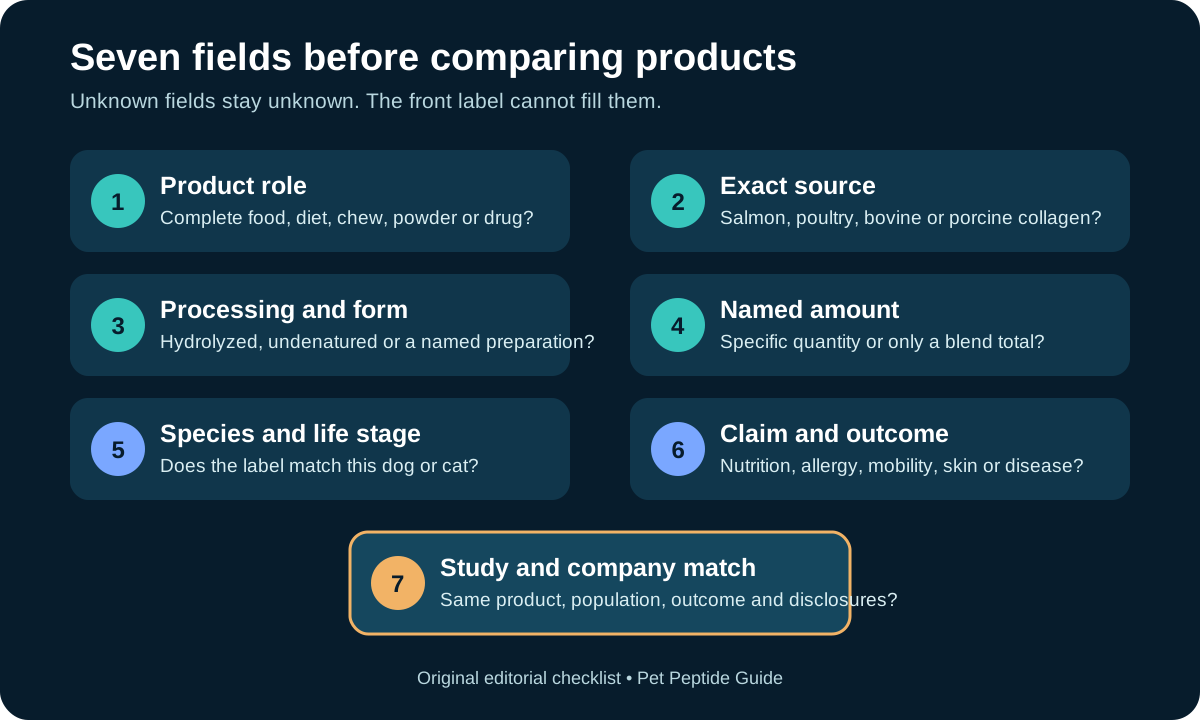
- Product role: Is it complete food, a veterinary diet, complementary feed, topper, chew, powder, drug or research material?
- Exact source: Does the label name salmon, poultry, chicken liver, bovine collagen, porcine collagen, type II collagen or another source?
- Processing and form: Is the material hydrolyzed, undenatured, a named peptide preparation or only described with a marketing phrase?
- Amount: Is the named ingredient amount stated for the actual serving, or is it hidden inside a blend total?
- Species and life stage: Is the product labeled for the animal being considered, and does a complete-food statement match the life stage?
- Claim and outcome: Does the label promise nutrition, diagnostic support, coat appearance, mobility, pain relief or disease treatment, and did the cited study measure that exact outcome?
- Study and company match: Does the cited paper test the same source, processing, formulation, population and finished product, and are funding or commercial interests disclosed?
FDA requires animal-food labels to identify the product, net quantity, responsible manufacturer or distributor and ingredients. Disease claims, or some non-nutritive structure-or-function claims, can indicate animal-drug intent. AAFCO also explains that nutritional adequacy, guaranteed analysis and feeding directions depend on the product’s role. Read the complete label rather than treating the front-panel phrase as the category.
Questions to bring to the veterinary visit
- Is the goal complete nutrition, a diagnostic elimination diet, joint support, skin assessment or another specific outcome?
- Does this animal need a complete food, a complementary product or a product-specific prescription pathway?
- Which exact protein or collagen source should the label name?
- Does the cited study test the same species, diagnosis, finished formulation and measured outcome?
- Is undenatured type II collagen being mislabeled as collagen peptides, or vice versa?
- Which ingredients changed together in the study, and can the result be assigned to one of them?
- Which neutral results, withdrawals, adverse events, funding and commercial interests should appear beside the favorable result?
- What should be monitored, and what result would mean the product is not meeting the intended goal?
Compare dog collagen labels and formats Open the daily-cost calculator
Frequently asked questions
Are collagen peptides a type of hydrolyzed protein?
They are produced by hydrolyzing collagen, but the useful label identity is more specific: collagen source, processing, fragment profile, amount and finished product. That does not make every hydrolyzed-protein pet food a collagen-peptide product.
Is undenatured type II collagen the same as collagen peptides?
No. The 2026 feline study used undenatured type II collagen in a complementary-feed chew. The 2024 canine study used a specific hydrolyzed bioactive collagen-peptide preparation. Their forms and evidence should remain separate.
Does a hydrolyzed diet treat every pet food allergy?
No. A veterinarian-directed elimination diet is an exact finished formulation used in a diagnostic and management process. Source protein, degree of hydrolysis, other ingredients, adherence and food challenge can matter.
Can a collagen supplement replace complete pet food?
No conclusion like that follows from a collagen study. Check the nutritional adequacy statement. A powder, chew or complementary feed should not be treated as complete daily nutrition unless the label lawfully says so for the correct species and life stage.
Does a dog collagen study prove a cat product works?
No. Species, diagnosis, collagen form, finished product and outcome must match. The separate feline undenatured-collagen record does not validate every cat collagen product.
Does this guide rank products?
No. No affiliate program is active, and this page includes no seller ranking, current price, feeding plan or treatment recommendation. It provides a label and study-matching framework.
What this means for a pet owner
Hydrolyzed protein and collagen peptides can both be legitimate label terms, but they answer different shopping and evidence questions. Start with the finished product’s role and the animal’s actual need. Then match source, processing, species, population and outcome.
If the label, study or product category does not match, do not bridge the gap with the words hydrolyzed, collagen or peptide. Keep unknowns visible, use the collagen label guide to read amounts and blends, and take the exact package and cited study to the veterinary discussion.
Sources and scope
This is an introductory guide or original comparison framework, not a systematic review or a product recommendation.
- Hsu et al. (2024): hydrolyzed protein in complete diets for healthy dogs — Primary five-period Latin-square study in ten healthy adult Beagles. Exact diets, neutral main skin/coat findings and employee affiliations remain visible.
- Lewis et al. (2025): hydrolyzed elimination diets in pruritic dogs — Primary multicenter, triple-blinded randomized crossover study. Fifty-seven dogs entered and 47 completed; diagnostic context, adverse-event collection, funding and employee conflicts remain attached.
- Scarpim et al. (2024): hydrolyzed poultry meal in cat diets — Primary abstract for 30 healthy cats across five extruded diets. Digestibility, fecal, urine and nitrogen outcomes are not converted into collagen or clinical-treatment evidence.
- Dobenecker et al. (2024): specific bioactive collagen peptides in canine osteoarthritis — Primary 12-week randomized, double-blind, placebo-controlled dog study. Exact porcine type I collagen-peptide preparation, mixed outcome pattern, completion, funding and interests retained.
- Piemontese et al. (2026): undenatured type II collagen crossover trial in cats — Primary abstract for a randomized, double-blind, placebo-controlled crossover study. Exact undenatured form and complementary-feed chew retained; it is not called collagen peptides.
- FDA: Animal Food Labeling and Pet Food Claims — Current official context for animal-food identity, ingredient labeling and when disease or non-nutritive structure/function claims can indicate animal-drug intent.
- FDA: Complete and Balanced Pet Food — Official context for nutritional adequacy statements and the AAFCO profile or feeding-trial basis of complete-and-balanced claims.
- AAFCO: Reading Pet Food Labels — Current authoritative consumer explanation of product names, ingredients, guaranteed analysis, nutritional adequacy and feeding directions. It is not product approval.
- AAFCO: Supplements — Current general context for baseline diet, added nutrients and supplement-label use. It is not product-specific safety or efficacy evidence.
Source checked November 06, 2026. A general context source does not establish a named product’s benefit.