
Peptides for Pet Skin and Coat: Which Outcome Was Measured?
Do peptides improve pet skin and coat? Separate dog and cat hydrolysate studies by species, diagnosis, formulation and actual outcome.
Do peptides improve a pet’s skin and coat? The reviewed evidence does not support that broad claim. One 2024 study compared complete diets containing different chicken protein hydrolysates in ten healthy adult Beagles and found no treatment differences in the main skin and coat analyses. A separate 2025 canine elimination-diet study reported changes in itch and dermatitis scores in dogs suspected of food reaction, which is a disease-management question rather than proof of a shinier coat. A 2024 cat hydrolysate study measured digestibility, fecal and metabolic outcomes, not skin or coat benefit. Keep the exact ingredient, species, diagnosis, complete formulation and measured outcome attached to every claim.

First name the outcome
Coat gloss, skin hydration, water loss, itch, lesions and wound closure are different outcomes. This guide shows which questions the reviewed companion-animal records actually answer.
This is an AI-assisted evidence explainer, not a systematic review or veterinary recommendation. Primary dog and cat studies plus current FDA and AAHA context were checked November 5, 2026. The existing cat skin guide covers feline allergic dermatitis and one approved cyclic polypeptide drug. The KPV dog itch guide audits a historical experimental claim. This page answers the different cross-species question of whether a food hydrolysate, experimental peptide or skin study supports a general “skin and coat” promise.
“Skin and coat” hides several different problems
A dull coat in an otherwise healthy animal is not the same research question as persistent itching, hair loss, inflamed skin, infection, a food reaction or an open wound. Even when two studies use the word “skin,” their populations and endpoints may have little in common.
The 2023 AAHA allergic-skin-disease guidance starts with history, examination and a minimum dermatologic database. It treats atopy as a diagnosis of exclusion and describes diet trials as part of a diagnostic process when food reaction is suspected. This matters because an improvement during a veterinary elimination diet does not transform every hydrolyzed ingredient into a cosmetic coat supplement.
Write the concern in measurable terms before reading a product claim. Is the question coat gloss, softness, dandruff, skin hydration, transepidermal water loss, itch frequency, lesion severity, hair regrowth or wound closure? A study supports only the outcome it measured in the population it enrolled.
Three hydrolysate records, three different questions
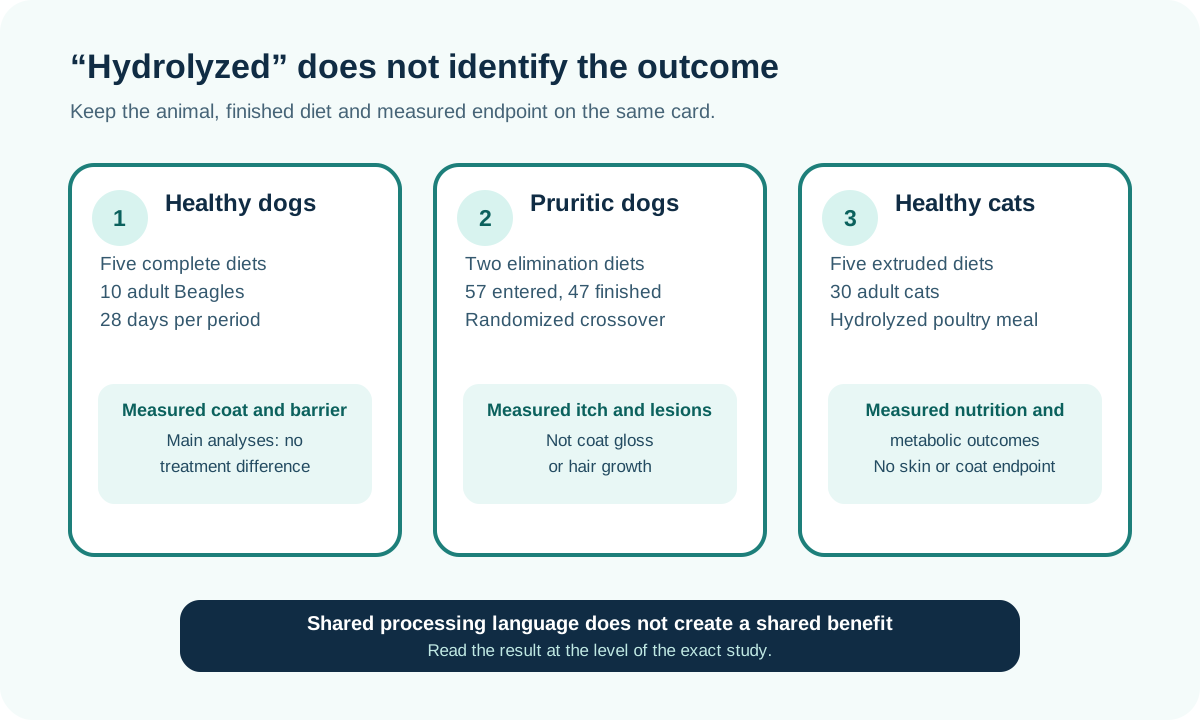
| Study card | Exact design | What was measured | What it does not establish |
|---|---|---|---|
| Healthy Beagles, 2024 | Ten neutered adult Beagles in a replicated five-period Latin-square study. Five complete and balanced diets used chicken meal, chicken liver and heart hydrolysate, chicken hydrolysate, or mixtures. Each treatment period lasted 28 days after a washout. | Coat gloss, softness, feel and scale; skin and hair scores; hydration, sebum and water loss; plus digestive, inflammatory and microbiome measures. | The main skin and coat analyses did not differ by treatment. The study does not establish a cosmetic benefit, disease treatment, cat result or class-wide effect of protein hydrolysates. Two authors were Kemin employees. |
| Pruritic dogs, 2025 | Fifty-seven dogs suspected of cutaneous adverse food reaction entered a multicenter, triple-blinded, randomized crossover study of two complete veterinary elimination diets: hydrolyzed salmon and hydrolyzed poultry feather. Forty-seven completed. | Owner itch score and canine dermatitis severity during two consecutive diet-trial periods, followed by challenge when food reaction was diagnosed. | Changes in itch or lesions do not prove coat gloss, hair growth or a generic peptide effect. The complete diets and diagnostic context matter. The study was funded by Blue Buffalo, and two authors were employees. |
| Healthy cats, 2024 | Thirty healthy adult cats received one of five extruded diets in which hydrolyzed poultry byproduct meal replaced conventional poultry byproduct meal at different inclusion levels. | Digestibility, fecal characteristics and fermentation products, urine measures, nitrogen balance and urea excretion. | The abstract does not report a skin or coat outcome. “Bioactive peptides” in the ingredient rationale are not a measured feline dermatology benefit. |
The healthy-dog study is especially useful because it actually measured several things buyers may mean by “skin and coat.” Its neutral result belongs in the summary. One left-ear sebum comparison differed at day 28, but changes from baseline did not differ across body regions, and the authors reported no treatment effect for the main coat scores, skin scores, hydration or water loss. A single favorable measurement should not replace the complete outcome pattern.
The pruritic-dog study asked a different question. Hydrolyzed diets can reduce exposure to some intact dietary proteins and are used in veterinary elimination trials, but insufficient hydrolysis, contamination or reaction to another ingredient can still matter. The study evaluated two finished complete diets in dogs being worked up for food reaction. It did not test an unidentified peptide powder, topical serum or coat chew.
The cat paper shows why species and endpoint checks come before marketing language. Its authors discussed digestibility, antigenicity and bioactive peptides as reasons to investigate hydrolyzed poultry meal. The experiment then measured nutrition and metabolic outcomes. It cannot be cited as direct evidence of feline skin or coat improvement.
Six outcomes should stay in separate lanes
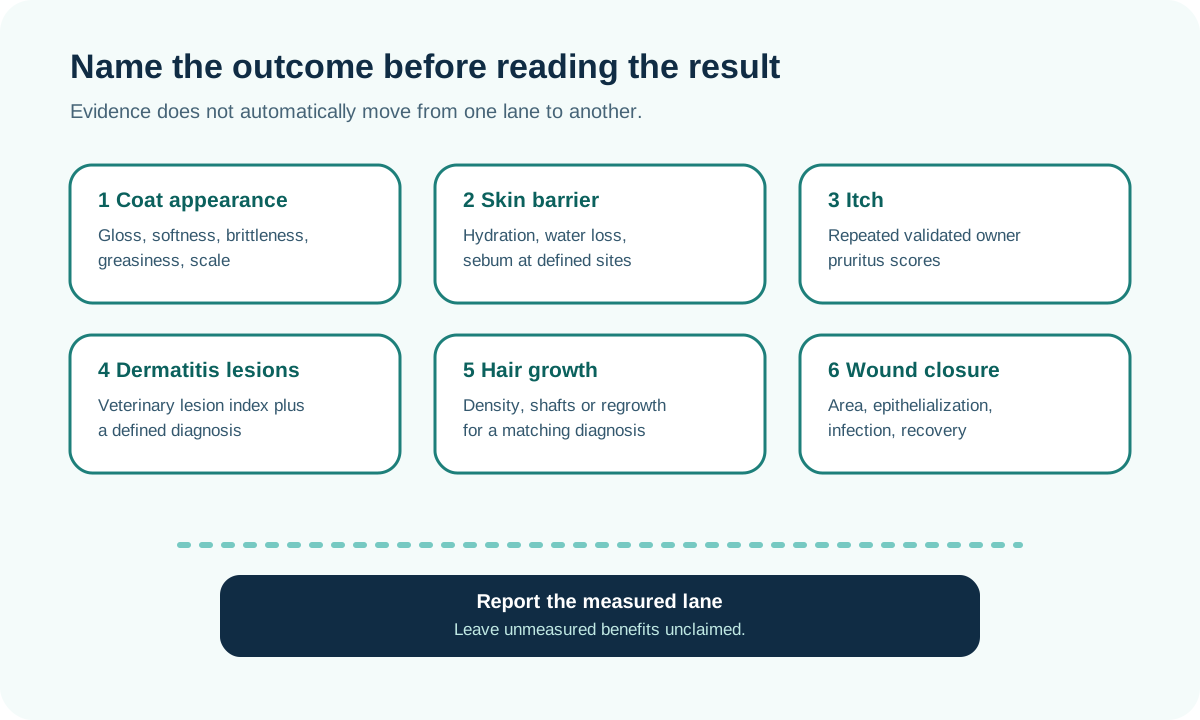
| Outcome lane | Examples of useful measures | Common evidence mistake |
|---|---|---|
| Coat appearance | Defined gloss, softness, brittleness, greasiness or scale scores with masked assessment where possible. | Calling improved itch a proven shinier coat. |
| Skin barrier | Hydration, transepidermal water loss and sebum at prespecified sites and time points. | Using a cell mechanism as proof of whole-animal barrier improvement. |
| Itch | A validated owner-assessed pruritus scale, repeated over an appropriate period. | Assuming less scratching identifies the cause or proves hair regrowth. |
| Dermatitis lesions | A defined veterinary lesion index plus diagnosis and control of parasites or secondary infection. | Generalizing a food-reaction population to every itchy animal. |
| Hair growth | Prespecified hair density, shaft or regrowth measures with a matching alopecia diagnosis. | Inferring growth from coat feel or from laboratory follicle work. |
| Wound closure | Wound area, epithelialization, infection and recovery measures in the exact wound type. | Converting wound research into evidence for chronic allergy or coat appearance. |
This is why GHK-Cu and KPV need their own evidence cards. A rat wound-chamber study of the exact GHK-Cu complex measured matrix-related wound outcomes, not coat quality in household dogs or cats. The historical canine itch material discussed on this site does not provide a controlled KPV-only finished-product trial. Neither record can fill an empty coat-benefit column.
Ingredient, complete diet and prescription drug are different categories
A protein hydrolysate is produced by breaking larger proteins into smaller components. The resulting ingredient can be part of a complete food, a veterinary elimination diet or another finished formulation. Degree of hydrolysis, source protein, all other ingredients and manufacturing controls affect whether research on one diet matches another product.
FDA’s current animal-food labeling page explains that labels must be truthful and that expressed or implied claims to diagnose, cure, mitigate, treat or prevent disease can indicate animal-drug intent. A non-nutritive claim to affect body structure or function can also matter. A “supports a glossy coat” food statement and a claim to treat allergic dermatitis do not carry the same intended use.
There are also product-specific prescription records. The FDA label for Atopica for Cats identifies cyclosporine as an 11-amino-acid cyclic polypeptide and specifies a feline allergic-dermatitis indication, oral route, prescription status, warnings and precautions. That approval stays with the exact product and indication. It does not validate a peptide supplement, dog diet, GHK-Cu cosmetic or KPV preparation.
Likewise, a large protein biologic used for canine itch should not be renamed as proof for small peptides. Molecular category, target, route, approved label and safety record all belong to the finished product.
Use a seven-field skin-and-coat check
- Concern and diagnosis: Is this normal coat variation, itching, lesions, hair loss, infection, food reaction or a wound?
- Species and population: Were the subjects healthy dogs, pruritic client-owned dogs, healthy cats, rodents, cells or humans?
- Exact identity: Was the intervention a hydrolyzed source protein, collagen preparation, GHK-Cu, KPV, a cyclic polypeptide drug or a large protein biologic?
- Finished formulation: Was it a complete diet, veterinary elimination diet, chew, powder, topical preparation or prescription drug?
- Route and duration: Did the marketed product match how and how long the studied intervention was used?
- Measured outcome: Was the result coat appearance, skin barrier, itch, lesion severity, hair growth or wound closure?
- Complete record: How many animals completed, which findings were neutral, what harms or withdrawals occurred, and who funded or held interests in the work?
If a seller supplies only the phrase “bioactive peptides,” ask for the exact ingredient name, finished-product label and the study claimed to support that product. The ingredient-versus-finished-product guide provides a longer worksheet. A shared category word is not a substitute for a match.
Questions to bring to the veterinary visit
- Which diagnosis best explains the itching, lesions, hair loss, dandruff or coat change?
- Do parasites, infection, pain, grooming behavior, nutrition or another disease need to be evaluated first?
- Which outcome should we track at home, and over what period?
- Does the cited study include the same species, diagnosis and finished formulation?
- Was the tested product a complete diet, an ingredient, a topical preparation or a prescription drug?
- Did the study measure the claimed outcome, or only a mechanism, digestive marker or different skin problem?
- Which neutral results, withdrawals, adverse events and funding relationships belong beside the favorable finding?
- What label, veterinary pathway and monitoring apply to this exact animal and product?
Open the free veterinary-visit checklist
Frequently asked questions
Do hydrolyzed proteins automatically improve a dog’s coat?
No. In the reviewed 2024 healthy-Beagle study, the main coat scores, skin scores, hydration and water-loss analyses did not differ among the complete diets. Another hydrolyzed diet study addressed itch and lesions in pruritic dogs, which is a different question.
Does an elimination-diet response prove a peptide supplement works?
No. A veterinary elimination diet is a complete formulation used in a diagnostic and management process. Its result does not establish efficacy for an unidentified supplement, topical product or another protein hydrolysate.
Does the cat hydrolyzed-poultry study show a skin benefit?
No. The reviewed feline paper measured digestibility, fecal, urine and nitrogen-related outcomes in healthy cats. Its abstract did not report a skin or coat endpoint.
Is wound-healing evidence the same as skin-health evidence?
No. Wound area, epithelialization and matrix measures answer a wound question. Chronic itch, allergic lesions, hair growth and coat appearance require their own populations and endpoints.
Is cyclosporine evidence transferable to a peptide supplement?
No. The feline record is an exact prescription product, route and allergic-dermatitis indication with product-specific safety information. It does not establish a class-wide benefit.
Does this guide recommend a skin or coat product?
No. It contains no affiliate offer, product ranking, dose, feeding schedule or treatment recommendation. It is a study-to-claim matching tool.
What this means for a pet owner
Start with the animal’s actual problem, then identify the outcome a study measured. The strongest directly relevant coat record reviewed here found no main treatment difference among five complete diets in healthy dogs. The canine food-reaction study supports a narrower discussion about two veterinary elimination diets and itch or lesion scores. The feline hydrolysate study does not supply a skin or coat outcome.
Keep those cards separate. Ask a veterinarian to help identify the cause of a skin or coat change and to decide which evidence, product record and monitoring fit the individual animal. When the species, formulation or outcome does not match, mark the claim unsupported rather than filling the gap with the word “peptide.”
Sources and scope
This is an introductory guide or original comparison framework, not a systematic review or a product recommendation.
- Hsu et al. (2024): hydrolyzed protein, skin and coat outcomes in adult dogs — Primary replicated five-period Latin-square study in ten healthy adult Beagles. Five complete diets, exact hydrolysate forms, neutral main skin/coat findings and employee conflicts are retained.
- Lewis et al. (2025): two hydrolyzed elimination diets in pruritic dogs — Primary multicenter, triple-blinded randomized crossover study. Fifty-seven dogs entered and 47 completed; itch and lesion outcomes, diagnostic context, funding and employee conflicts remain visible.
- Weemhoff et al. (2021): controlled food trial in dogs with adverse food reaction — Primary abstract for a controlled double-masked multicenter food study with PVAS, CADLI, activity and coat-questionnaire outcomes. Complete diets are not reduced to a peptide ingredient claim.
- Scarpim et al. (2024): hydrolyzed poultry meal in cat diets — Primary abstract for 30 healthy cats across five extruded diets. Digestibility and metabolic outcomes were measured; no skin or coat endpoint is inferred from the bioactive-peptide rationale.
- Maquart et al. (1993): GHK-Cu in rat wound chambers — Primary rat wound record for the exact glycyl-histidyl-lysine copper complex. Used only to keep wound evidence separate from dog/cat coat, itch and chronic-dermatitis claims.
- FDA: Animal Food Labeling and Pet Food Claims — Current official context for truthful animal-food labels and when disease or non-nutritive structure/function claims can indicate animal-drug intent.
- FDA labeling: Atopica for Cats, NADA 141-329 — Official product-specific label identifying cyclosporine as an 11-amino-acid cyclic polypeptide with an exact feline indication, route, warnings and precautions. No dosing instructions reproduced.
- AAHA: 2023 Management of Allergic Skin Diseases in Dogs and Cats Guidelines — Current authoritative diagnosis and management context for history, dermatologic workup, diagnostic exclusions and diet trials. Guideline synthesis, not a peptide experiment.
Source checked November 05, 2026. A general context source does not establish a named product’s benefit.