
Semaglutide vs Tirzepatide vs Retatrutide for Pets
Can human weight-loss results rank semaglutide, tirzepatide and retatrutide for pets? Compare compounds, species, formulations, outcomes and current status.
Can human weight-loss results rank semaglutide, tirzepatide and retatrutide for dogs or cats? No. The headline percentages come from different human trials with different compounds, receptor targets, populations, durations, estimands and approval states. The reviewed dog semaglutide paper measured absorption of a specific oral formulation, not weight loss. The reviewed cat paper used exenatide, not any of these three compounds. A human trial result cannot fill the missing canine or feline clinical-outcome column.

Compare like with like before naming a winner
Keep the molecule, species, finished formulation, measured outcome and current product status on the same row. Shared receptor language does not make three medicines interchangeable.
This AI-assisted article is a focused evidence comparison, not a systematic review, treatment ranking or veterinary recommendation. Primary trials, current FDA human labels, FDA animal-drug context and the current FDA warning about unapproved GLP-1 products were checked November 7, 2026. No dose, injection instruction, conversion, seller, research-chemical link or pet treatment protocol is provided.
Three compounds, three identities
Semaglutide acts at the GLP-1 receptor. Tirzepatide acts at GIP and GLP-1 receptors. Retatrutide acts at GIP, GLP-1 and glucagon receptors. Those descriptions identify receptor targets. They do not establish that a compound is suitable for a particular dog or cat, and they do not allow one compound's human trial to serve as another compound's veterinary evidence.
Current U.S. prescribing information identifies Wegovy as a human semaglutide product and Zepbound as a human tirzepatide product. Their labeled populations and finished formulations are product-specific. Retatrutide has a published 2026 phase 3 human trial, but FDA's current unapproved GLP-1 page states that retatrutide is not a component of an FDA-approved drug and cannot be used in compounding under federal law. A published trial and a product approval are separate records.
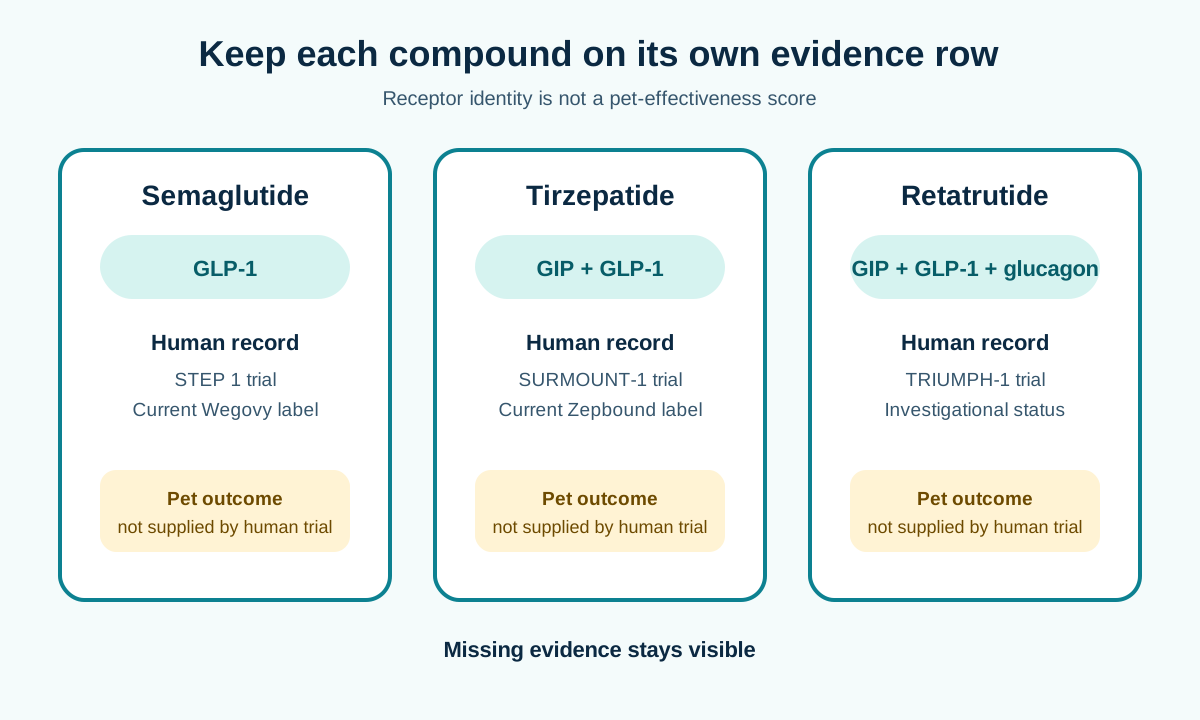
| Compound | Receptor identity | Current source reviewed | Pet conclusion that does not follow |
|---|---|---|---|
| Semaglutide | GLP-1 receptor agonist. | Current Wegovy human label; STEP 1 human obesity trial; dog oral-formulation absorption research. | That a dog absorption experiment proves canine weight loss, diabetes control or safety. |
| Tirzepatide | GIP and GLP-1 receptor agonist. | Current Zepbound human label; SURMOUNT-1 human obesity trial. | That a human dual-receptor result transfers to dogs, cats or semaglutide. |
| Retatrutide | GIP, GLP-1 and glucagon receptor agonist. | TRIUMPH-1 phase 3 human obesity trial; current FDA unapproved-product context. | That three receptor targets mean greater pet benefit, an approved product or a lawful research listing. |
Why the human weight-loss percentages do not create a pet ranking
STEP 1 randomized 1,961 adults with overweight or obesity and without diabetes to semaglutide or placebo alongside lifestyle intervention for 68 weeks. SURMOUNT-1 randomized 2,539 adults with obesity, or overweight plus a weight-related complication, and without diabetes to tirzepatide or placebo for 72 weeks. TRIUMPH-1 randomized 2,339 adults with obesity and without diabetes to retatrutide or placebo for 80 weeks.
All three trials measured human body-weight change, but similarity in the headline outcome does not make the trials a head-to-head comparison. Their study periods, treatment strategies, populations, handling of events after treatment changes, formulations and analysis plans differ. Reading the largest published percentage as the strongest pet option would add two unsupported steps: a cross-trial ranking and a human-to-animal transfer.
The funding context also belongs with the result. STEP 1 was funded by Novo Nordisk. SURMOUNT-1 and TRIUMPH-1 were funded by Eli Lilly. Sponsor funding does not erase a study, but it is part of the record a careful comparison retains beside design, attrition, endpoints and analysis.
| Trial | Population and duration | Main question | Why it cannot rank pet care |
|---|---|---|---|
| STEP 1 | 1,961 adults without diabetes; 68 weeks. | Body-weight change with semaglutide versus placebo alongside lifestyle intervention. | No dogs or cats, no veterinary diagnosis, and no comparison with tirzepatide or retatrutide. |
| SURMOUNT-1 | 2,539 adults without diabetes; 72 weeks. | Body-weight change with tirzepatide versus placebo. | No companion animals and no direct comparison with semaglutide or retatrutide. |
| TRIUMPH-1 | 2,339 adults without diabetes; 80 weeks. | Body-weight change with retatrutide versus placebo, plus specified human comorbidity outcomes. | No companion animals, a different analysis plan, and retatrutide remains outside an FDA-approved finished drug. |
What the dog semaglutide paper actually measured
Buckley and colleagues investigated how an oral semaglutide formulation coformulated with the absorption enhancer SNAC crossed the stomach lining. The work included beagle studies and characterized gastric absorption under specific experimental conditions. It was a formulation and exposure study.
The dog work did not enroll client-owned dogs with obesity or diabetes, compare long-term weight-management plans, measure durable body-condition change, or establish a canine safety profile for clinical use. It also does not validate an injectable product, a tablet with a different enhancer, tirzepatide, retatrutide or a compounded preparation.
This distinction matters because a paper can include dogs while answering a formulation-development question for a human medicine. The species word alone does not identify the study's clinical purpose.
The cat GLP-1 paper used a fourth compound
Klotsman and colleagues studied an investigational implant designed to release exenatide in healthy purpose-bred cats. The work included two cadavers, a four-cat tolerability component and a 15-cat proof-of-concept component. Researchers measured implant handling, plasma exenatide and body weight over short study periods.
That study shows why the compound and delivery system must remain in the title of the evidence row. Exenatide is not semaglutide, tirzepatide or retatrutide. Healthy purpose-bred cats are not the same population as client-owned cats with a diagnosed condition. A prototype implant is not an approved retail pen, tablet or compounded vial.
The paper's weight observations belong with its early proof-of-concept design, small groups, short follow-up and company involvement. They do not provide a three-drug feline ranking.
Human approval does not become a pet label
FDA explains that an animal drug legally marketed through the approval pathway carries a New Animal Drug Application or Abbreviated New Animal Drug Application number on most current labels. The Wegovy and Zepbound documents reviewed here are human prescribing information, not dog or cat labels.
A veterinarian may have legally relevant options involving approved human or animal drugs under specific circumstances, and FDA separately describes patient-specific animal compounding when an appropriate approved option cannot meet the animal's medical need. Those pathways require a real veterinary relationship and product-specific judgment. They do not turn a human trial table into a pet dosing chart or make an online research listing an approved animal drug.
FDA's current unapproved GLP-1 page also warns about products falsely labeled for research purposes or not for human consumption. This article does not link to or compare those sellers.
Use the six-field transfer check
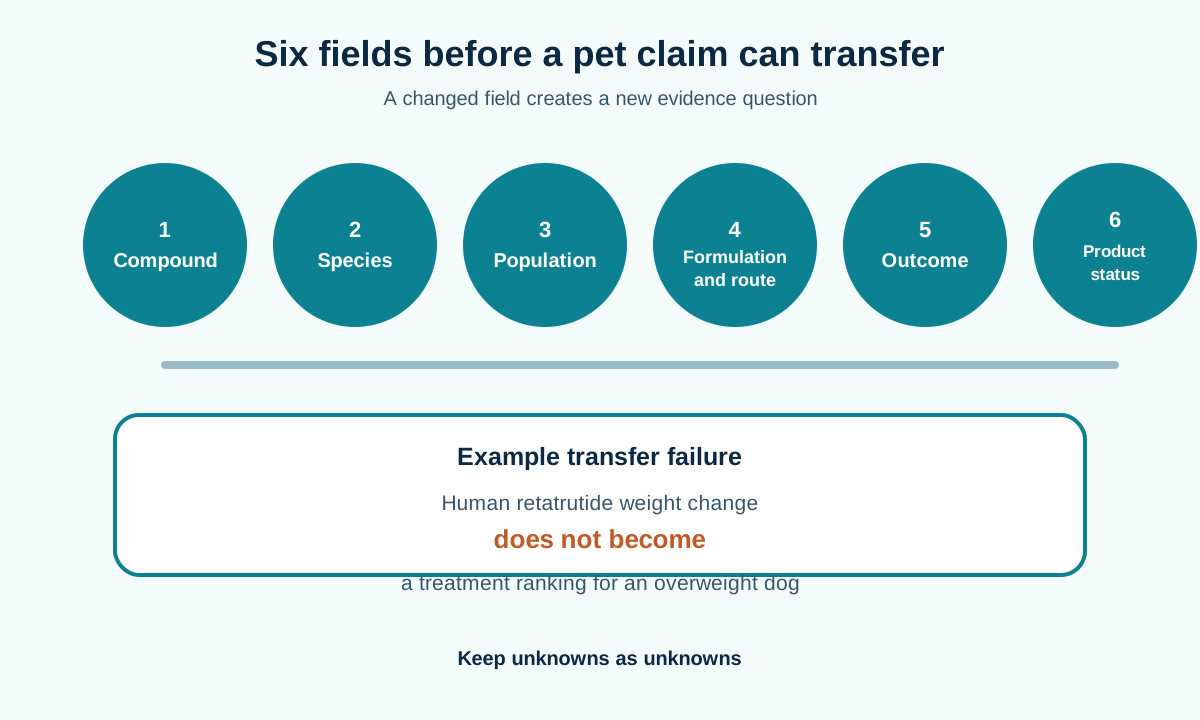
- Compound: Is the source about semaglutide, tirzepatide, retatrutide, exenatide or another molecule?
- Species: Were the subjects people, dogs, cats or laboratory animals?
- Population: Were they healthy research animals, client-owned patients, adults with obesity or another defined group?
- Formulation and route: Was the intervention a specific injection, tablet with an absorption enhancer, implant or another finished form?
- Outcome: Did the study measure absorption, body weight, glucose control, body condition, activity, quality of life or adverse events?
- Product status: Is there a current label for the intended species and indication, a veterinarian-directed pathway, an investigational program or only a research listing?
Worked headline check: “Triple agonist produces the greatest weight loss” can accurately describe a particular result in a particular human trial only when its population, duration and analysis stay attached. Rewriting it as “retatrutide is best for overweight dogs” changes the species, care setting, product status and comparison. Those gaps are not minor details.
Questions to bring to the veterinary visit
- What explains this animal's weight change, appetite change or glucose concern, and what diagnosis should come first?
- Which body-condition, diet, activity, laboratory or medication records would make the discussion useful?
- Is the source about the exact compound and finished formulation being discussed?
- Does any cited dog paper measure clinical benefit, or only exposure and absorption?
- Does any cited cat paper use the same compound, population and delivery system?
- What current label or regulatory record identifies the product and intended species?
- What meaningful outcome and follow-up would be monitored for this animal?
- What adverse effects, interactions, contraindications or alternative explanations need evaluation?
Read the semaglutide source guide Open the vet-visit checklist
Frequently asked questions
Is retatrutide stronger than tirzepatide or semaglutide for pets?
The reviewed studies do not establish a pet ranking. Retatrutide's 2026 phase 3 result concerns adults with obesity, and FDA's current page says retatrutide is not a component of an approved drug. Receptor count and a human trial percentage do not establish canine or feline benefit.
Was semaglutide tested in dogs?
A reviewed paper included beagles in research on gastric absorption of a specific oral semaglutide and SNAC formulation. It did not test long-term weight loss, diabetes treatment or everyday function in client-owned dogs.
Was tirzepatide tested in dogs or cats?
The primary source compared here is a human obesity trial. This focused review did not verify a dog or cat clinical-outcome trial for tirzepatide. That is a source limit, not proof that no relevant research could exist anywhere.
Does the exenatide cat implant study support semaglutide?
No. It is useful evidence that a GLP-1 receptor agonist and an implant delivery system were investigated in cats, but exenatide, semaglutide, tirzepatide and retatrutide are different compounds.
Does FDA approval for a human medicine mean a veterinarian can use it in every pet?
No. A human label identifies a human finished product and human indications. Veterinary decisions depend on the animal, diagnosis, product, applicable pathway and professional oversight. An online listing does not replace those records.
Can the site's peptide calculator convert a human dose for my pet?
No. The calculator only converts an amount already supplied by a veterinarian and a confirmed pharmacy-label concentration into volume. It does not select a dose, scale a human amount by body weight, choose a route or recommend a product.
What this means for a pet owner
Semaglutide, tirzepatide and retatrutide belong in separate evidence rows. Human weight-loss trials are real evidence for their enrolled human populations and exact interventions. The dog semaglutide study answers an absorption question. The cat exenatide study answers an early implant question. None creates a head-to-head pet treatment ranking.
Start with the animal's diagnosis and the exact product record, then use the six-field check. The tirzepatide guide and retatrutide guide keep their individual sources and status visible. For a broader decision framework, use the veterinary product-pathway guide.
Sources and scope
This is an introductory guide or original comparison framework, not a systematic review or a product recommendation.
- FDA: Wegovy (semaglutide) prescribing information, 2026 — Current human prescribing information checked November 7, 2026. It is not a dog or cat label and no human dosing instructions are reproduced.
- FDA: Zepbound (tirzepatide) prescribing information, 2026 — Current human prescribing information checked November 7, 2026. Exact dual-receptor identity and human indications retained; no veterinary inference.
- Wilding et al. (2021): STEP 1 semaglutide trial — Primary randomized human obesity trial: 1,961 adults without diabetes, 68 weeks. Human body-weight results are not converted into pet evidence.
- Jastreboff et al. (2022): SURMOUNT-1 tirzepatide trial — Primary randomized human obesity trial: 2,539 adults without diabetes, 72 weeks. No head-to-head pet conclusion.
- Jastreboff et al. (2026): TRIUMPH-1 retatrutide trial — Primary phase 3 human obesity trial: 2,339 adults without diabetes, 80 weeks. Publication does not establish animal approval or pet use.
- Buckley et al. (2018): oral semaglutide and SNAC absorption — Primary formulation and absorption research including beagles. Not a canine weight-loss, diabetes, function or long-term safety trial.
- Klotsman et al. (2021): exenatide implant proof of concept in cats — Primary early cat study of exenatide and a prototype implant. Exact compound, healthy purpose-bred population, small components and company involvement retained.
- FDA: Concerns with unapproved GLP-1 drugs used for weight loss — Current human regulatory context checked November 7, 2026. Retatrutide status and research-use marketing warning retained without linking sellers.
- FDA: How to tell if a drug is legally marketed for animals — Current official animal-label record check, including NADA or ANADA identifiers. It does not turn a human label into an animal approval.
- FDA: Animal Drug Compounding — Current veterinarian-directed compounding context. Compounded animal drugs are not FDA-approved finished animal products.
Source checked November 07, 2026. A general context source does not establish a named product’s benefit.