
Peptides for Pet Joint Health: Does the Study Match Your Dog or Cat?
Do peptides support pet joint health? Compare dog and cat collagen studies by species, formulation, diagnosis and outcome before carrying a claim to a product.
Do studies support peptides for pet joint health? Only for narrow, product-specific questions. A 2024 study tested one oral bioactive collagen peptide preparation in dogs with osteoarthritis. A 2026 study tested an undenatured type II collagen chew in cats with degenerative joint disease. Another cat study tested a complete diet containing hydrolyzed collagen plus several other active ingredients. These records cannot be combined into proof that a generic “pet peptide” product helps every dog or cat. Match the species, diagnosis, exact formulation and measured outcome before carrying a result to a product.

Keep every result on its study card
This guide helps owners evaluate a “pet joint health” claim that borrows research from dogs, cats or a different collagen form. It does not rank treatments, recommend a product or supply a dose.
This is an AI-assisted evidence explainer, not a systematic review or veterinary recommendation. Three primary companion-animal studies and current FDA animal-food claim pages were checked November 4, 2026. The article adds a cross-species transfer test; the existing dog arthritis and cat arthritis guides contain diagnosis and species-specific detail.
Why “pet joint health” is too broad for one evidence claim
“Pet” can mean dogs, cats or other species. “Joint health” can mean comfort, movement, daily activity, joint structure or prevention. “Peptide” can describe food-derived collagen peptides, an undenatured collagen preparation, an experimental compound or, in loose marketing language, even a large protein biologic. Those differences change the research question.
A useful claim must be narrower: one identified intervention, in one species and population, by one route, compared with a stated control, for defined outcomes over a stated period. If a seller cites a dog study for a cat chew, or an undenatured collagen study for a hydrolyzed collagen powder, the evidence match has already broken.
Start with the animal and diagnosis. Limping, reluctance to jump, slower movement or stiffness can have several causes. A veterinarian must determine whether osteoarthritis, an injury, another painful condition or a non-joint problem best explains the change. Research about diagnosed osteoarthritis does not diagnose a pet from a search phrase.
Three joint studies, three different questions
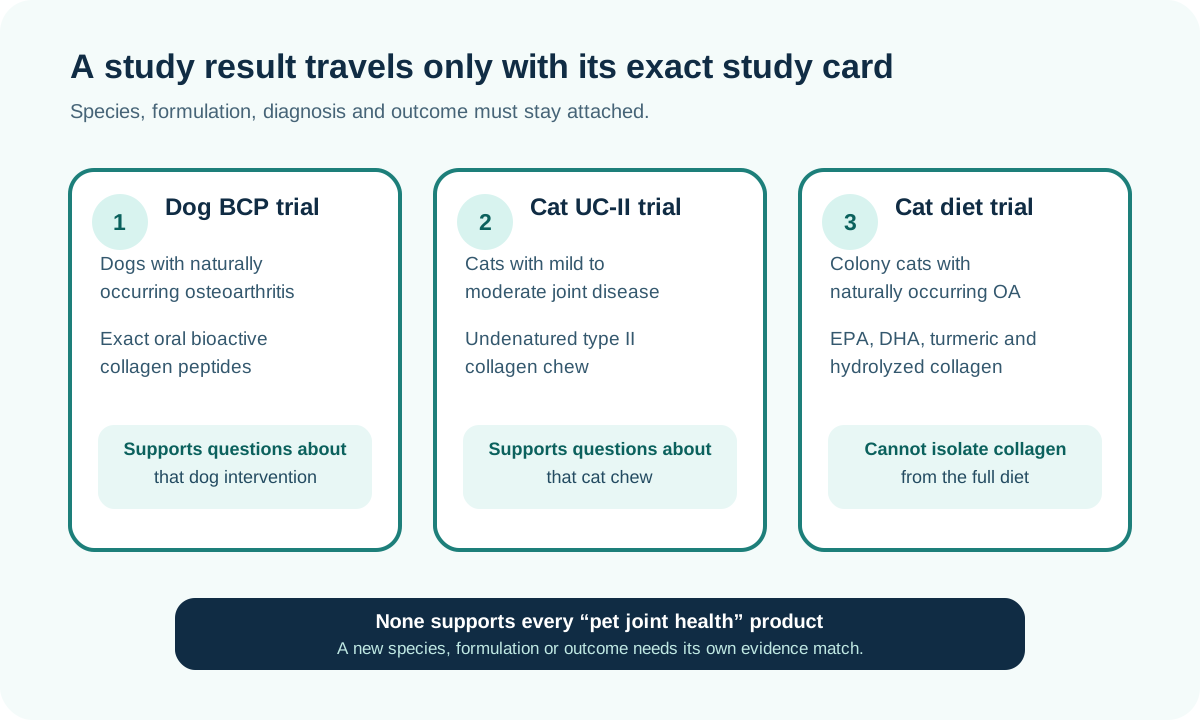
| Study card | Exact intervention and design | Outcomes measured | Transfer limit |
|---|---|---|---|
| Dog bioactive collagen peptide study, 2024 | Client-owned dogs with naturally occurring osteoarthritis; one oral bioactive collagen peptide preparation; randomized, double-blind, placebo-controlled; 41 enrolled and 31 completed 12 weeks. | Force-plate treadmill measures, Canine Brief Pain Inventory and accelerometry. Several kinetic and quality-of-life measures improved; accelerometer activity did not. | Does not establish benefit for cats, every collagen form, every finished product, structural repair or prevention. GELITA funded the study; employee and patent interests were disclosed. |
| Cat undenatured type II collagen study, 2026 | Client-owned cats with mild to moderate degenerative joint disease; one complementary-feed chew; randomized, double-blind, placebo-controlled crossover; 20 entered and 14 completed all visits. | Caregiver-specific outcome measures, feline musculoskeletal pain score and quality-of-life measures during defined crossover periods. | Does not establish equivalence to hydrolyzed collagen peptides, a powder, a dog product or every cat. Small completion count, caregiver outcomes and author affiliation belong in the reading. |
| Cat multi-ingredient diet study, 2024 | Thirty colony cats with naturally occurring osteoarthritis; complete diet containing EPA, DHA, turmeric extract and hydrolyzed collagen; randomized, blinded and controlled. | Force-plate movement, stair use, nighttime activity and a veterinary assessment instrument over the study phases. | The ingredients changed together, so the study cannot identify collagen as the cause. A complete diet is not equivalent to a single-ingredient supplement. |
The dog study is the closest of the three to a canine collagen-peptide outcome question. It still supports only its exact preparation and study conditions. The cat chew study concerns undenatured type II collagen, which should not be relabeled as generic hydrolyzed collagen peptides. The cat diet study concerns a package of ingredients. Taking one component out of that package changes the intervention.
These distinctions matter when shopping. Use the dog collagen buying guide or cat collagen evidence and label guide to compare the actual finished-product form with the cited study. Neither page treats a shared word on two labels as proof of equivalence.
Five outcomes hidden inside “joint health”
A claim can overreach even when species and product match. Pain, mobility, daily activity, joint structure and prevention are separate endpoints. A favorable caregiver score does not prove cartilage repair. A force-plate change does not prove that an animal moved more throughout the day. A short osteoarthritis trial does not establish prevention in a healthy pet.
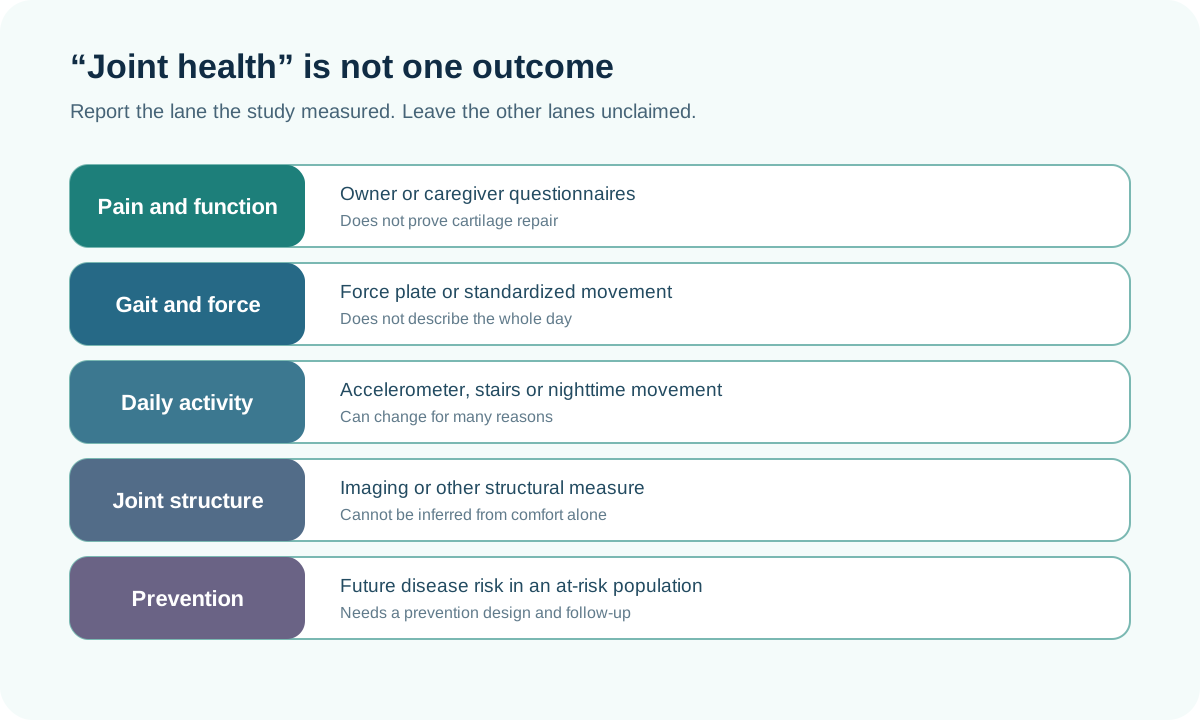
| Claim language | Evidence needed | Common overreach |
|---|---|---|
| “More comfortable” | A validated pain or pain-interference measure in the matching species and diagnosis. | Using a laboratory mechanism or blood concentration as proof of pain relief. |
| “Moves better” | Defined gait, force, stair, jump or mobility measures with a comparator. | Replacing a measured movement task with a general whole-life benefit. |
| “More active” | Daily-life activity measurement over enough time, with other routine changes considered. | Inferring daily activity from a brief clinic test. |
| “Repairs joints” | A prespecified structural outcome and an appropriate design. | Inferring tissue repair from comfort or mobility alone. |
| “Prevents joint problems” | An at-risk population, a prevention endpoint and adequate follow-up. | Turning treatment research in diagnosed disease into prevention advice. |
Product category changes what a claim means
FDA explains that animal-food labeling must be truthful and that claims to diagnose, cure, mitigate, treat or prevent disease can indicate animal-drug intent. Claims about changing the structure or function of an animal through a non-nutritive mechanism can also cross that line. The agency gives joint-function language in an arthritic dog as an example in its pet-food regulation discussion.
This does not mean every food or supplement-style statement has been reviewed as an animal-drug claim. It means a buyer should identify the regulatory category before treating a marketing sentence as evidence. A food, complementary feed, prescription animal drug, compounded preparation and research listing have different records and controls.
FDA-approved monoclonal antibodies for osteoarthritis pain in dogs and cats provide an important contrast. Bedinvetmab and frunevetmab are product-specific prescription protein biologics with their own species, indication, label and safety information. Their approvals do not validate collagen powders, BPC-157, TB-500 or a general peptide category. The species-specific arthritis guides explain those records without turning them into a treatment comparison.
Use a seven-match check before carrying a study to a product
- Species: Was the study in dogs, cats, another animal, humans, cells or tissue?
- Population and diagnosis: Did the animals have the same diagnosed condition, or were they healthy laboratory animals?
- Exact identity: Was the intervention hydrolyzed collagen peptides, undenatured type II collagen, a multi-ingredient diet, a drug or something else?
- Finished formulation and route: Does the marketed powder, chew, diet or prescription product match what was studied?
- Comparator and duration: Was there placebo, control food or crossover, and how long did observation last?
- Outcome: Was the result pain, gait, daily activity, structure, prevention, exposure or a laboratory marker?
- Complete record: How many completed, which results were neutral, what adverse events occurred, and who funded or held interests in the work?
If any field differs, write down the difference. Do not bridge it with a testimonial or the word “pet.” The ingredient research versus finished-product guide provides a longer worksheet, and the free veterinary-visit checklist helps carry the unresolved fields into an appointment.

Questions to bring to the veterinary visit
- What diagnosis best explains the change in movement, comfort or activity?
- Which two or three home activities should we record before changing the care plan?
- Does the cited study include this species and the same diagnosis?
- Does the exact collagen form, finished formulation and route match the product being considered?
- Which outcome changed, and which attractive claims were not measured?
- Were the favorable results accompanied by neutral results, withdrawals or relevant conflicts?
- Is this a food, supplement-style product, prescription animal drug, compounded preparation or research listing?
- What current label, disease, medicine, nutrition and monitoring information applies to this animal?
Open the free veterinary-visit checklist
Frequently asked questions
Can a dog joint study support a cat product?
Not by itself. The species mismatch remains even if the ingredient names look similar. A cat product also needs a match on diagnosis, exact formulation, route and outcome.
Are undenatured type II collagen and collagen peptides the same?
No. They are different preparations. Research on an undenatured type II collagen chew should not be presented as direct evidence for an unidentified hydrolyzed collagen peptide powder.
Does a multi-ingredient diet prove that collagen worked?
No. When EPA, DHA, turmeric extract, hydrolyzed collagen and the complete diet change together, the trial evaluates the package. It cannot isolate collagen as the cause of the result.
Does better mobility mean the joint was repaired?
No. Mobility and structural repair are separate outcomes. A repair claim needs a prespecified structural measure rather than an inference from pain, gait or activity.
Are BPC-157 or TB-500 proven for pet joint health?
The reviewed dog BPC-157 paper measured pharmacokinetics in six healthy beagles, not joint outcomes. The site’s TB-500 identity review does not identify a matched dog or cat osteoarthritis clinical trial that establishes benefit. Neither record supplies a pet joint-health protocol.
Does this page recommend a joint product?
No. It is a study-to-product matching tool. It contains no affiliate offer, product ranking, dose or treatment recommendation.
What this means for a pet owner
A joint-health result is useful only at the level it was studied. Preserve the animal, diagnosis, formulation, comparator, duration and measured outcome. The dog bioactive collagen peptide trial, cat undenatured type II collagen trial and cat multi-ingredient diet trial answer different questions. None creates a universal “peptides for pets” conclusion.
Use that narrower record to ask a veterinarian whether the research matches the animal and product in front of you. When a field is missing, label it unknown rather than buying certainty from a broad category claim.
Sources and scope
This is an introductory guide or original comparison framework, not a systematic review or a product recommendation.
- Dobenecker et al. (2024): specific bioactive collagen peptides in canine osteoarthritis — Primary 12-week randomized, double-blind, placebo-controlled dog study. Exact intervention, mixed outcome pattern, attrition, funding and disclosed interests retained.
- Piemontese et al. (2026): undenatured type II collagen crossover trial in cats — Primary randomized, double-blind, placebo-controlled crossover record. Twenty client-owned cats entered and 14 completed all visits; exact chew and collagen form retained.
- Lefort-Holguin et al. (2024): multi-ingredient therapeutic diet in feline osteoarthritis — Primary controlled feline study. EPA, DHA, turmeric extract and hydrolyzed collagen changed together, so the diet result cannot isolate collagen.
- FDA: Animal Food Labeling and Pet Food Claims — Current official context for truthful animal-food labeling and when disease or non-nutritive structure/function claims can indicate animal-drug intent.
- FDA: Regulation of Pet Food — Official food-versus-drug intended-use context, including the agency’s arthritic-dog joint-function example; not product-specific evidence.
- FDA: bedinvetmab approval for canine osteoarthritis pain — Product-specific canine prescription monoclonal-antibody approval context; not evidence for collagen or experimental peptides.
- FDA FOI Summary: Solensia original approval, NADA 141-546 — Product-specific feline prescription monoclonal-antibody approval record; not evidence for collagen or experimental peptides.
- Brown et al. (2008): Canine Brief Pain Inventory treatment response — Primary canine osteoarthritis outcome-method study used to keep validated pain/function outcomes separate from gait, activity, structure and exposure.
Source checked November 04, 2026. A general context source does not establish a named product’s benefit.